Meridiem #1: What does the recent bond market volatility tell us about Turkish politics?

After the failure of negotiations following the 2026 round of the US-Israel war against Iran, not only did tensions in West Asia go up, but also bond yields across the globe went up.
Despite their limited success in destabilizing the Iranian regime and destroying critical infrastructure, I think it is fair to suggest that U.S. power has been undermined because of the early 2026 round of the war. First, unsystematic and haphazard military attacks, along with vessels accompanying ships passing through the Strait of Hormuz, highlighted the limits of U.S. power. Second, various Gulf countries and the U.S.'s partners suffered from the ensuing market volatility, higher energy prices, and the geostrategic risks that are difficult to price. Not only will some Gulf countries record close-to-zero growth rates or suffer from a recession, but their primary export item is becoming less reliable, given the circumstances and the emerging availability of stronger alternatives.
Since the observers expected the brief pause to come to an end by May 18-19, the financial markets (the participant individuals, the investing institutions, and those with leveraging power) foresaw a longer period of uncertainty covering the rest of the year, with higher energy prices and further negative impact on energy-importing countries across the world. WTI Crude (July contract) is over USD100, and Brent Crude (July contract) is around USD110 a barrel at the time of writing, around the same level as when it became clear by early April 2026 that the U.S. framing of the war found no buyer in the discursive field of the public opinion markets anymore.
Various mechanisms and indicators affect bond yields; this time round, higher yields or a faltering in bond prices followed changes in expectations of future revenues due to higher oil prices. By late May, inflation expectations higher than in early 2026 push financial investors to prefer short-term instruments or demand more to stay in long-term fixed-income instruments. High inflation and possibly higher policy rates in the following months have been priced in. Rising bond yields can also continue weighing on stock market expectations, as many sectors with inputs from conflict-prone regions or ties to volatile markets expect tighter markets and near-term profits lower than they were a few months ago.
Even though Turkish bonds share a similar path with many others in the global South, higher inflation and the austerity program in Türkiye create further controversy. The annual percentage change in consumer prices in emerging and developing countries (the term the IMF uses to roughly denote the global South) was 5.5 percent in April 2026, whereas the same indicator stood at an astounding 32.3 percent in Türkiye. I should remind you that the austerity program and measures reminiscent of stabilization programs have been in place for more than thirty months.
Below you see a screenshot of Turkey 10Y Bond Yields (I borrowed the graph from the Trading Economics webpage). The bond yield was below 30 percent at the start of the Şimşek program (autumn 2023, even though Şimşek assumed the role in June 2023). Despite orthodox measures and occasional inflows of foreign portfolio investment, Turkish policymakers could not reverse inflation expectations (as shown in the graph below, with rising bond yields over time). The sudden jump by March 2025 was due to the arrest of some major opposition party members and high-profile politicians, including the then presidential candidate of the main opposition party. The second jump, in late February and early March 2026, stems from the start of the US-Israel war against Iran, once again changing inflation expectations in Türkiye in the short-to-medium term.
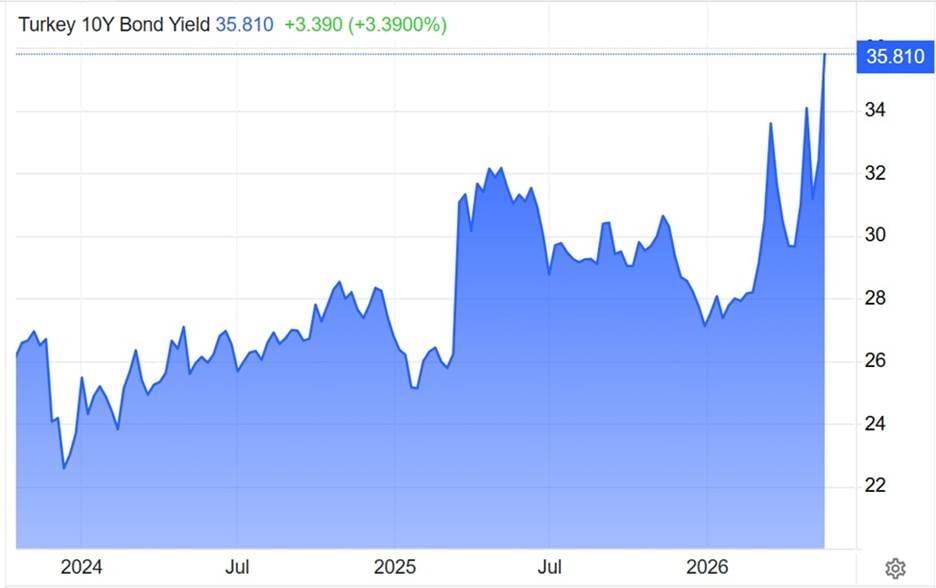
Here is what this recent jump means for the next few months:
We will see an intensification of calls for a new industrial strategy/policy, coming from both the Independent Industrialists and Businessmen’s Association (MUSIAD) and the Turkish Industry and Business Association (TUSIAD). Even though the meaning of industrial policy varies across sectors in the Turkish context, discontent with the orthodox outlook, though eased by frequent subsidies and occasional cheap-credit campaigns, will grow further.
Erdogan-style authoritarianism is obsessed with electoral validation, even though elections function more like plebiscites. and have been riddled with further controversy since 2015 (not that irregularities did not exist before, but their outcome-changing impact has increased in the last decade). Although there were rumours of a very limited constitutional change (to be approved by referendum), which could also support, along with a new round of legal reforms, the new steps in negotiations with the Kurdish armed movement, it is now almost impossible to imagine a constitutional referendum or plebiscite before mid-2027. Under these circumstances, Turkish politics will witness new heights and practices of pressure against the main opposition party and whoever amasses considerable power that they plan to harness on the road to plebiscites.
Highlight:
We spent a considerable amount of time in 2025 analyzing municipal infrastructure finance in Canada and how public alternatives work and might be implemented to address the ongoing infrastructure deficit. You can download and read the policy brief:
Güngen, Ali Riza and Marois, Thomas (2026). ‘Local, Efficient, Public: A New Municipal Development Bank for Canada?’ PBP Policy Brief. No. 2026/01. McMaster University, Canada. Public Banking Project.
Article:
I recommend reading a few pieces from the climate finance collection of Finance and Space. I admit I have just started.
Governing climate change through finance: risk, institutions and sustainability politics
Link here: https://www.tandfonline.com/journals/rfas20/collections/Governing-climate-change-through-finance
Video/Podcast:
Catherine Liu’s take on identity politics is something I would endorse only within the context of U.S. politics, and Liu’s class analysis is somewhat problematic given its cultural focus and its limited scope with an American lens. But it is worth listening to:
How liberals monetized trauma | Catherine Liu on Marx, Trump, and identity politics
Popular culture:
Eurovision 2026 results were unfair due to Israel’s organized voting campaign and government promotion, as well as EBU censure during the stream (as in 2024 and 2025). Even though the NYT violated some fundamental principles of journalism during the genocide, they published the most comprehensive Eurovision analysis, demonstrating what is wrong with the competition in the past three years. If you do not have time to read it all, just review the Spain voting data from 2025. 2000 people with the power to change the country's public vote results! Says it all.
How Israel Turned Eurovision’s Stage Into a Soft Power Tool