Storms have been weathered for the Erdogan administration, but new clouds are gathering over the Turkish economy

The cost of ousting the leader of the main opposition party, which is leading in the polls and organizing opposition through court decisions, might be high in any regime with multi-party elections and room for protests and different voices. Spreading the effects over time and postponing some of the harms can be a way of managing volatility, as is happening in Türkiye over the last three weeks.
Since May 21, the three indicators – reserves, interest rates, and asset dollarization – that observers should pay attention to in the Turkish economy tell us that the storm for the Erdogan administration is now mostly weathered. There are no directly observable negative impacts of the political storm, which might put a definite end to the expectation of following Hungary's path (electoral defeat of incumbent authoritarians by explicit contenders or once-allied groups).
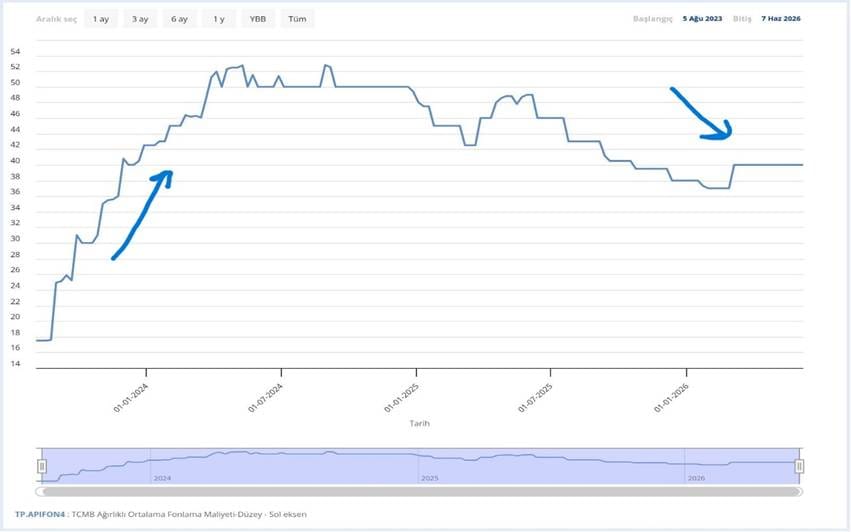
Central Bank reserves, excluding swaps, hovered around 20 billion USD and reached 29.4 billion USD by last week. The change indicates that the volume of the reserves lost during the last weeks of May 2026 is now around 10 billion USD. Foreign exchange deposits of resident individuals remained a few billion USD below their May 2026 level (around 147 billion USD) with no signs of dramatic changes on the horizon. And CBRT reviewed its policy interest rate, deciding to maintain the policy rate at 37 percent and the overnight interest rate at 40 percent on June 11. Despite the official rate remaining the same, the average funding rate has been 40 percent since the first week of the US-Israel’s 2026 war against Iran. The average funding rate is a blow to the credibility of the Şimşek team, since they spent a great deal of time in late 2025 promising that funding costs would dramatically diminish in 2026, a doubling down on the trend that had already begun by mid-2025. Below, you can see this change in the average funding cost, which gives us a clearer picture than the policy rate. This is becausepolicy rates occasionally remain only on paper, and the gap between the official rate and the actual cost of funding widens considerably.
Given the apparent calm in financial markets and the near-zero change in two of the three key indicators, with the third (reserve loss) being very mild, the Erdogan administration has clearly managed the situation (in the short term). Despite this appearance, there are various clouds on the near horizon by June 2026. I would like to take you to Şimşek's interview on June 8, 2026.
Answering questions on the cost of war in the Middle East and the medium-term economic programme, Şimşek reiterated that the benefits of their steps outweigh the costs and they are delivering on every front, not just financial stability, but also real sector support. To further explain, he gave the example of rediscount credits provided for export-oriented sectors:
Şimşek: We increased the paid-in capital of Eximbank [a public bank supporting export-oriented sectors] from 13 billion TRY to 100 billion TRY.
Hakan: So, why are they [exporters] unhappy?
Şimşek: Wait a minute, I will explain.
Source: CNNTurk live stream, June 8, 2026
Following this exchange, Şimşek provides several examples of support in the form of cheap loans, rediscount credits, and assumed losses stemming from the interest payments of shopkeepers and farmers. This exchange is significant because the host (a mouthpiece for the Erdogan administration) feels obliged to voice the exporters' discontent. And Şimşek misinforms the public by claiming that Eximbank's paid-in capital increased eightfold. But a quick search shows that the eightfold increase occurred over almost five years, which means the real increase in Eximbank's paid-in capital will be around 10-15 percent, or possibly less, by the end of this year.
These figures can make the Şimşek team feel delighted. They forwarded this to Erdogan to use in his speech the previous day for the Foreign Economic Relations Board meeting. But it carries little significance for exporters, who demand more credit and more options. Among many examples, I chose the one voiced immediately after the Central Bank's interest rate decision. A member of the Malatya Chamber of Commerce and Industry claimed that the credit limit for small and medium-scale enterprises (3 million TRY) within the low-interest loan program specifically designed for SMEs that are members of the Union of Chambers and Commodity Exchanges of Türkiye is too low, given their financing needs. This credit provides a principal grace period, but the loan rate is not as low as desired by small- and medium-scale producers and exporters (see the video below).
Source: BloombergHT, June 11, 2026.
Why is the economic administration not paving the way for cheaper loans as they did before (in 2016, in 2018, and on several other occasions during and after the Covid-19 pandemic)? This is due to the fear of dollarization of assets. It seems that not only the household asset dollarization but also the FX rush by small- and medium-scale enterprises, following the cheap-loan campaigns, continue to haunt policymakers' memories. The Credit Guarantee Fund loans and rediscount credits are offered, but the limits remain unchanged; the volume, comparatively, is lower (under high inflation) than in previous credit expansion episodes; and exporters remain unhappy with the loan structures, limits, and their financing prospects.
Here is what you can expect given the gathering clouds:
As I mentioned in the last issue, comprehensive incentives and new targeted credit programmes are a must if the average cost of funding is not diminished by more than a few hundred basis points in a few months. There remains the risk of dollarization, not just among resident individuals but also among corporations.
The Şimşek team has to go on with their plans, but their steering wheel is not working as intended. Controlling the depreciation of the Turkish Lira helps mitigate inflationary pressures, but it cannot mitigate the side effects of the economic program. When they do, they will also have to rely on public banks and spend more reserves to limit currency depreciation.
Of course, another method is to keep positive policy interest rates and suppress the demand further, but it is not sustainable since the lower growth rates are what the conservative Erdogan administration hates the most, even more than higher policy rates and definitely higher inflation.
Highlight:
Possible currency swaps by the Fed with Türkiye's Central Bank were the subject of speculation following commentary from some investment bankers in late May. Various emerging countries in the global South, as well as major powers such as China, also engage in currency swaps. But these currency swaps have limited utility and, in China's case, are slowing the internationalization of the renminbi. I recommend reading “How China swaps: the operation of RMB currency swaps in emerging and developing markets and their impact on currency internationalisation”, by Aditi Sahasrabuddhe, published a few days ago in New Political Economy.
Also, the new issue of Praksis was released by Dipnot last week. I loosely translate the issue title as Debating the Capitalist State – Again. I hope to review a few articles in the following weeks.
Interview:
Drawing on Susan Strange's four pillars of structural power — production, finance, knowledge, and military — Schwartz assesses where American dominance is eroding and where it persists. Empire Suicide Watch is a fascinating interview to read.
Video/podcast:
I discussed some of the ideas and data presented in Newsletters #3 and #4 with my colleague Umit Akcay in our online series hosted by Evrensel. Check out our latest episode: Büyüme, enflasyon, faiz: Türkiye ekonomisi nereye? | Kriz Notları